Tetra

Black Skirt Tetra

Black Skirt Tetra (Gymnocorymbus ternetzi): Care Guide

Black Skirt Tetras (Gymnocorymbus ternetzi) are a species of freshwater fish native to the waters of South America. Within South America, they’re commonly found in bodies of water in Argentina, Brazil, Bolivia, and the Paraguay and Guapore River basins. Black skirt tetras can go by several different names, and some of them are Petticoat Tetra, Blackamoor, and Black Widow Tetra. Unlike their relatives, Black Skirt Tetras aren’t colorful fish. Towards the front of their body, they have a silver coloration. Towards the back of their body, they have a dark coloration. While they do not bright colors on their body, they are beautiful fish and remain just as popular as other tetras.

Congo Tetra

Congo Tetra (Phenacogrammus interruptus): Care Guide

Congo Tetra (Phenacogrammus interruptus) is a common freshwater aquarium fish that is relatively easy to care for. They were discovered in 1949 in the Congo River basin, as their name suggests. In the wild, they live in small streams, ponds, and marshes. They are schooling fish that congregate in enormous numbers. This schooling behavior can be observed in an aquarium as well, creating a stunning focal point in the tank.

Rummy Nose Tetra

Rummy Nose Tetra (Hemigrammus bleheri): Care Guide

Rummy Nose Tetra (Hemigrammus bleheri) is a tropical freshwater fish native to South America. This fish can be found in Rio Negro in Brazil and Rio Vaupes in Columbia. The Rummy Nose Tetra has many nicknames such as Fire Head Tetra, Red Nose Tetra, and Brilliant Rummy Nose Tetra. This iridescent fish is playful with their tank mates which makes them a great addition to an aquarium and is so fun to watch.

Payara Fish

Payara Fish Facts & Care (AKA Vampire Tetra)

The Payara Fish (Hydrolycus scomberoides), also known as Vampire Tetra, is an aggressive, predatory species of dogtooth tetra that can be found swimming in the tropical waters of the Amazon Basin, actively hunting for its next meal.
Payara fish belong to the Dogtooth Characins family and are not to be confused with the similar Hydrolycus armatus. Payara fry are born with gaps in their upper jaw to accommodate their razor-sharp fangs, that juts out menacingly and can reach up to six inches long.

Candy Cane Tetra

Candy Cane Tetra: Care, Size, Food, Tank Mates & Aggression

Candy Cane Tetras (Hyphessobrycon bentosi) have an almost salmon colored hue to their bodies. This coloration can range from the light salmon to a more pinkish hue. They are similarly colored to the Rosy Tetra, but the Candy Cane Tetra has a more transparent body. The fins of the Candy Cane Tetra have a bright red on them, and they will always have white tipped dorsal fins. Candy Cane Tetra can also be identified by a faintly colored, greyish shoulder patch. It is easier to tell the males from the females when they reach maturity. The males tend to have longer dorsal fins, and the females tend to be more plump.

Phoenix Tetra Care: Diet, Lifespan, Size, Breeding & More

Phoenix Tetras are a vibrant fish with a grey silvery body, and their body also has a delicate gold colored sheen. Their fins have a beautiful red coloration with white extensions that look very ornate. Mature females are noticeably more stocky than the males are. The males have longer filaments on their fins, and they show off a flashy bright red color. The caudal fin is translucent in color in the female Phoenix Tetra. Mature male Phoenix Tetra have elongated dorsal and anal fins. These differences make it easy to distinguish male Phoenix Tetras from females.

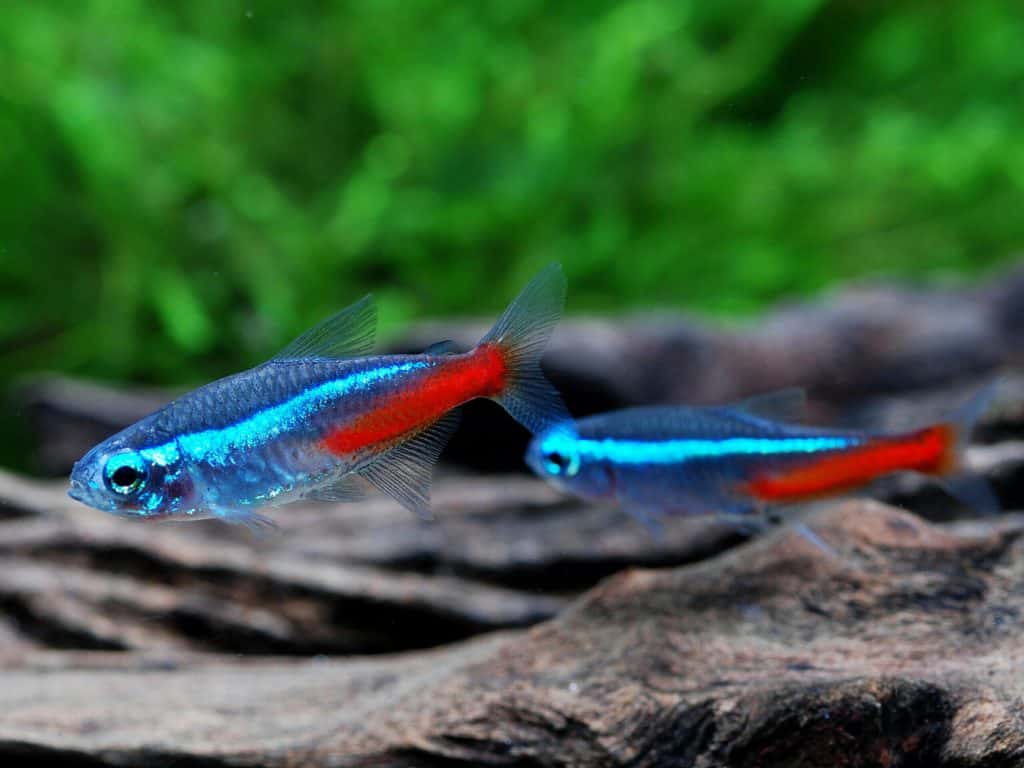
Neon Tetra: Care, Disease, Breeding, Albino & Gold Types

Neon Tetra has a light blue back over a silver colored abdomen. It has an iridescent blue stripe that runs horizontally along each side of the fish, starting at the nose and ending at the adipose fin. They also have a red iridescent stripe that begins in the middle of their body and extends to the base of the caudal fin. The neon tetra is partially transparent, the fins too. Female Neon Tetras are usually bigger, can be identified by their rounder bellies, and a bent iridescent stripe rather than the male’s straight one. At night time, as the Neon Tetra rests, the red and blue stripes become gray and black. The color becomes vibrant again once the Neon Tetra becomes active in the morning.