Flame Moss

Flame Moss: Care Guide for a Super Fire Aquarium Moss

The flame moss, also known by its scientific name, the Taxiphyllum sp. ‘Flame’, is a unique species of creeping moss, whose prominence amongst hobbyists is heightening. Naturally found in South Asia and South-East Asia, it thrives mainly in different bushes of cold river water with a gradual flow. The flame moss is known for the extraordinary way it grows.

Hillstream Loach

Hillstream Loach (Sewellia lineolata): Care Guide

Reticulated Hillstream Loaches originate from Vietnam and can be found in fast-flowing waters located within Laos; Quang Ngai; Thua Thien-Hue; Binh Dinh and Quang Nam. They have hydrodynamic characteristics, such as a smooth body (their scales are tiny), depressed undersides, wing-like pectoral and pelvic fins and rays. Their underside and fins work as powerful ventral discs, which give them the ability to cling onto stones and smooth surfaces while facing violent currents.

Rotala Indica

Rotala Indica: Care Guide for an Awesome Aquarium Plant

Rotala Indica, nicknamed Indian toothpick, is a type of flowering plant native to Southeast Asia. Discovered in 1881 by German botanist Bernhard Adalbert Emil Koehne, a renowned professor of botany in Berlin, who also authored the Lythraceae family of plants. Although native to Southeast Asia, Rotala Indica has been introduced to other regions such as Italy and Portugal, as well as California and Louisiana in the United States.

Least Killifish

Least Killifish (Heterandria Formosa): Care Guide

Least Killifish (Heterandria Formosa) is also known as the little killifish, dwarf topminnow, or midget livebearer. It is a fish species native to the southern United States. Coming from the Poeciliidae family, this fish is one of the smallest fish worldwide, and it is in fact the smallest fish that is native to North America. It is one of the few fish that is endemic to the North America. Although they are not the most colorful fish in the aquarium hobby, it is a unique fish that is very interesting to keep. They are calm and docile fish that can breed in your home aquarium.

Firefish Goby

Firefish Goby: Care, Tank Size, Tank Mates, Breeding & Diet

Firefish Goby (Nemateleotris Magnifica), also known as red-fire goby, the fire dartfish, or the magnificent firefish is a species of dartfish that can be found mainly in the coral reefs surroundings of the Pacific and Indian oceans. Particularly from the coast of eastern Africa to the Islands of Hawaii and the Austral Island upwards to the islands of Ryukyu. The Firefish Goby is a stunning saltwater fish with impressive colorations and an astounding body shape, as well as a remarkable personality. And so it is one of the multiple famous fishes kept by many people in the aquarium.

Rainbow Shark (Epalzeorhynchos frenatum)

Rainbow Shark: Care, Size, Tank Mates, Tank Size & Food

Rainbow Sharks are incredibly sensitive and aquarists must be vigilant when it comes to ensuring their water quality remains superb. This species can easily become distressed if water parameters drop or spike without warning, making the Rainbow Shark even more aggressive, which can be a problem if it lives in a community tank. Rainbow Sharks need well-oxygenated, soft water that mimics its native habitat, therefore a hardness level of 3 to 14 dKH is ideal. As a general rule, a pH between 6 to 8 is best, however hobbyists should aim for the middle of this range. Ammonia and Nitrite levels must be kept at 0 ppm, because even 2ppm can cause disease and stress for Rainbow Sharks. Nitrate levels should never exceed 20ppm. Their water ought to remain clean, with weekly cycles of 20% to 30%.

Jardini Arowana

Jardini Arowana (Scleropages jardinii): Care Guide

The Jardini Arowana, also known as the Australian Arowana, is a carnivorous, tropical, freshwater fish that is native to Australia and New Guinea. This species has a jaw lined with spikey teeth perfect for chomping on its prey. Scientifically known as Scleropages jardini, this fish has coined the nickname Water-Monkey due to its tendency to frequently hop out of the water to grab its prey or when startled. Jardini Arowana fossils have been discovered that show they lived during the Jurassic era. This makes them one of the most prehistoric fish found in aquariums today.

Micro Sword

Micro Sword Plant (Lilaeopsis brasiliensis): Care Guide

Micro Sword plants (Lilaeopsis brasiliensis) are widely used by aquarium owners to create a beautiful environment for their fish swim in and potentially used to breed in. The plant is usually placed in the foreground of the aquarium, and it significantly improves tank aesthetics. Micro Sword resembles grass and can be easily grown in water, emersed or submersed. Aquarium owners trying to recreate the effect of a grass – like carpet for their aquariums can try Micro Sword plants.

Venustus Cichlid

Venustus Cichlid Care Guide (Nimbochromis venustus)

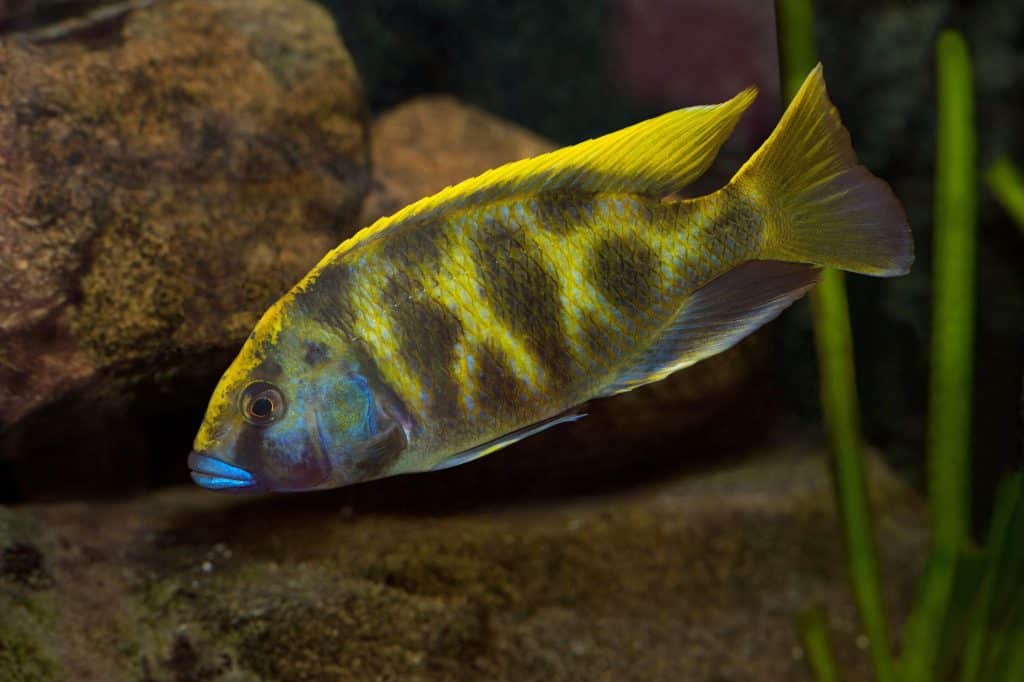
Venustus Cichlids (Nimbochromis venustus) are good for intermediate-level fish keepers, because despite their simple care needs, they are only semi-hardy. This moderately-aggressive species must have a tank suitable enough for them to swim around in, as they are very active fish. Their dietary needs are easily met, but they can easily become ill if their water conditions are anything but superb. Depending on the bioload, aquarists will need to change their water weekly (minimum 10% to 20%).

Dovii Cichlid

Dovii Cichlid: Care, Size, Tank Mates, Aggression & More

Dovii Cichlid (Parachromis dovii), also known as the Wolf Cichlid, is a species of cichlid that can be found in various lakes and rivers throughout Central America, primarily in lake Nicaragua, Costa Rica, and Honduras. Due to its unique colorful appearance, it is one of the most popular fish kept by a good number of people. They are true predators and are a fascinating species of cichlid.