Freshwater Fish

Peacock Eel

Peacock Eel (Macrognathus siamensis): Care Guide

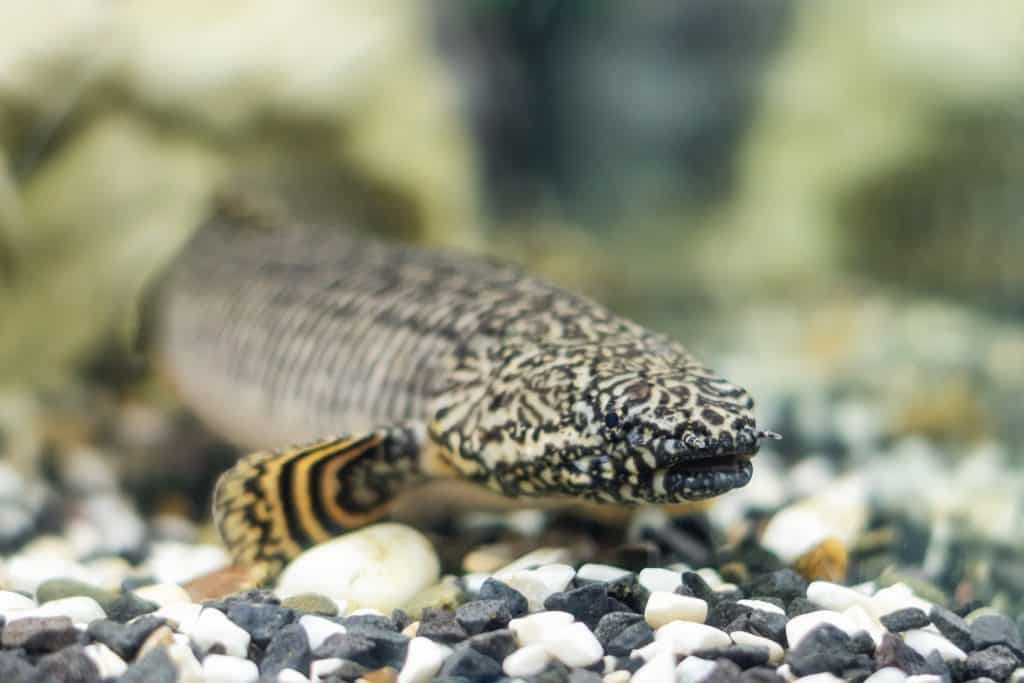
The body of the Peacock Eel (Macrognathus siamensis) is elongated and has a pointed snout. The dorsal and anal fins are both prolonged to the caudal fin, which is a tiny fin. These fish can reach a length of over 12 inches (30 cm) and live for 8 to 18 years.

The Peacock Eel’s main color is light brown, with a thin pale yellow stripe extending from the eye to the tail’s base. They’re most commonly seen buried in the soft substrate with only their heads peeking out on the bottom of slow-moving or motionless waters. These locations are frequently densely forested.

Flying Fox Fish

Flying Fox Fish (Epalzeorhynchos kalopterus): Care Guide

Flying Fox Fish can be seen at the bottoms of fast-moving freshwater currents of Indonesia (The Greater Sunda Islands, specifically Borneo, Java, and Sumatra), Peninsular Malaysia/Thailand, and Singapore. Flying Fox Fish migrate seasonally to forested areas and bottomlands during the rainy season, however, this has been disturbed due to urbanisation and habitat destruction. In the last few decades, their populations have depleted significantly and their distribution means wild-caught specimens are unobtainable.

Clown Killifish

Clown Killifish: Care, Size, Breeding & Tank Mates

Clown Killifish are one of the most social species of fish; they’re also extremely curious. When you walk past the tank, they’ll often swim close to the glass to see what’s going on. Their colorful pattern and upbeat demeanor will quickly make them a favorite in your tank. Killifish comes from the Dutch word for a channel, which makes sense because they’re found in slow-moving streams, or swamps in Africa.

Odessa Barb

Odessa Barb: Care, Size, Tank Mates, Aggression & Lifespan

The Odessa Barb, scientifically known as the Pethia padamya, is an omnivorous freshwater tropical fish native to South East Asia and the Himalayas. This fish can be found in countries such as China, India, Nepal, and Thailand in shallow freshwater streams. This vibrant Barb has been given the name Scarlett Barb due to its iridescent colorful scales that scatter its body. The Odessa Barb is so well known and loved for its silly playful nature and zipping all around its tank.

Least Killifish

Least Killifish (Heterandria Formosa): Care Guide

Least Killifish (Heterandria Formosa) is also known as the little killifish, dwarf topminnow, or midget livebearer. It is a fish species native to the southern United States. Coming from the Poeciliidae family, this fish is one of the smallest fish worldwide, and it is in fact the smallest fish that is native to North America. It is one of the few fish that is endemic to the North America. Although they are not the most colorful fish in the aquarium hobby, it is a unique fish that is very interesting to keep. They are calm and docile fish that can breed in your home aquarium.

Rainbow Shark (Epalzeorhynchos frenatum)

Rainbow Shark: Care, Size, Tank Mates, Tank Size & Food

Rainbow Sharks are incredibly sensitive and aquarists must be vigilant when it comes to ensuring their water quality remains superb. This species can easily become distressed if water parameters drop or spike without warning, making the Rainbow Shark even more aggressive, which can be a problem if it lives in a community tank. Rainbow Sharks need well-oxygenated, soft water that mimics its native habitat, therefore a hardness level of 3 to 14 dKH is ideal. As a general rule, a pH between 6 to 8 is best, however hobbyists should aim for the middle of this range. Ammonia and Nitrite levels must be kept at 0 ppm, because even 2ppm can cause disease and stress for Rainbow Sharks. Nitrate levels should never exceed 20ppm. Their water ought to remain clean, with weekly cycles of 20% to 30%.

Delhezi Bichir

Delhezi Bichir (Polypterus delhezi): Ultimate Care Guide

The Delhezi Bichir (Polypterus delhezi), also known as the barred, banded, or armored bichir, is a nocturnal, carnivorous catfish of ancient origins, a native of the Congo River’s middle section, in Central Africa. Mottled with yellow and green specks over roughly a dozen short black stripes, this living fossil is a unique, hardy fish that …

Delhezi Bichir (Polypterus delhezi): Ultimate Care Guide Read More »

Leopard Puffer

Leopard Puffer Fish Care (Dichotomyctere nigroviridis)

Leopard Puffer Fish (Dichotomyctere nigroviridis), also known as Green Spotted Puffer, have a yellow green body with a whitish cream colored belly. Their bodies have different shaped and sized black spots on them. They become more brightly colored as they mature. They have a rounded shaped body, with large eyes. Their eyes have a brilliantly yellow colored middle. They have tiny mouths, with teeth inside. These teeth grow very quickly, and will require you to physically clip them from time to time so that they do not become overgrown. It is easier to tell the males from the females once they have matured. The male Leopard Puffer will have darker markings on his body, and the female will have a more rounded appearance.

pea puffer

Pea Puffer: Care, Size, Food, Tank Mates & Tank Size

Pea Puffers (Carinotetraodon travancoricus) are small fish that at full maturity grow up to 1.5 inches. They are a yellow green color, with black spots on their bodies. These spots are both large and small. The eyes of the Pea Puffer appear larger than their head. They have a body that is larger towards the head, and gets smaller as it goes towards the tail.

Gardneri Killifish

Gardneri Killifish (Fundulopanchax gardneri): Care Guide

Gardneri Killifish (Fundulopanchax gardneri) are beautiful fish that are great for small to medium sized aquariums.

Their name derives from the Dutch word ‘killy’ which means a ditch or canal. As their name suggests, they are often found in shallow waters such as water-holes, streams, and marshes. Since they are adapted to these shallow bodies of waters, Killifish generally do not grow very large.