Aquarium Plants

Red Tiger Lotus

Red Tiger Lotus (Nymphaea zenkeri): Ultimate Care Guide

Red Tiger Lotus is a beautiful plant that is ideal for beginners. This resilient species can withstand practically any condition, making it ideal for any aquarist, regardless of experience. Red Tiger Lotus got its name from the color of its leaves, which are bright red. A Red Tiger Lotus is a lily pad. Some people are surprised by this because Red Tiger Lotus have arrowhead-shaped leaves rather than the circular leaves that people are used to seeing on lily pads. Under bright light, the red leaves might exhibit striped variegation.

Flame Moss

Flame Moss: Care Guide for a Super Fire Aquarium Moss

The flame moss, also known by its scientific name, the Taxiphyllum sp. ‘Flame’, is a unique species of creeping moss, whose prominence amongst hobbyists is heightening. Naturally found in South Asia and South-East Asia, it thrives mainly in different bushes of cold river water with a gradual flow. The flame moss is known for the extraordinary way it grows.

Rotala Indica

Rotala Indica: Care Guide for an Awesome Aquarium Plant

Rotala Indica, nicknamed Indian toothpick, is a type of flowering plant native to Southeast Asia. Discovered in 1881 by German botanist Bernhard Adalbert Emil Koehne, a renowned professor of botany in Berlin, who also authored the Lythraceae family of plants. Although native to Southeast Asia, Rotala Indica has been introduced to other regions such as Italy and Portugal, as well as California and Louisiana in the United States.

Micro Sword

Micro Sword Plant (Lilaeopsis brasiliensis): Care Guide

Micro Sword plants (Lilaeopsis brasiliensis) are widely used by aquarium owners to create a beautiful environment for their fish swim in and potentially used to breed in. The plant is usually placed in the foreground of the aquarium, and it significantly improves tank aesthetics. Micro Sword resembles grass and can be easily grown in water, emersed or submersed. Aquarium owners trying to recreate the effect of a grass – like carpet for their aquariums can try Micro Sword plants.

Dwarf Baby Tears

Dwarf Baby Tears (Hemianthus callitrichoides): Care Guide

Dwarf Baby Tears (Hemianthus callitrichoides) is a semi-aquatic plant in the Linderniaceae family. They are also known as Water Starwort, and they can be found in the West Indies. This includes Cuba, Puerto Rico, and The Bahamas. This plant is believed to have been first collected by Holger Windeløv and Eusebio Canicio Delgado Pérez in 2003 in Las Pozas, Cuba. With their lush green cluster of leaves, Hemianthus callitrichoides began to hit the retail shelves in the United States in 2008. Nowadays they can be found in most stores such as Home Depot and Walmart, as well as online retailers such as Amazon and Etsy. If shopping online, you want to be particularly careful you are purchasing the correct Dwarf Baby Tears, as dwarf baby tears can sometimes be mistaken for Monte Carlo.

Subwassertang

Subwassertang (Lomariopsis Lineata): Ultimate Care Guide

When first looking at the pronunciation of Subwassertang (Lomariopsis Lineata), it’s essential to know that the word stems from the German words “süßwasser” and “tang,” which means “freshwater” “seaweed.” Subwassertang has been a popular aquarium plant since its discovery in the early 2000s. Ever since Christel Kesselman propagated it and gave it out to some fellow aquarists, which then became the new must-have plant, how it got into her aquarium originally is still unknown.

Java Moss (Taxiphyllum barbieri)

Java Moss Care Guide: Growing a Carpet in Aquarium and More

Java Moss is perfect for beginner fish keepers wishing to introduce this moss into their aquarium. Experimenting with where to place this moss can be interesting, as their rhizoids allow them to attach to any surface, granted this makes controlling its growth somewhat difficult. A tank size of at least 5 gallons (19 L) is needed, but depending on how often Java Moss is pruned and whether more than two moss are planted, their growth will need to be accommodated with a 10 gallon (38 L) tank. Low fluorescent or LED lights are recommended for Java Moss, as they do not require bright lights, especially as this will spur algae reproduction.

Hydrocotyle Tripartita

Hydrocotyle Tripartita Care: Ultimate Guide

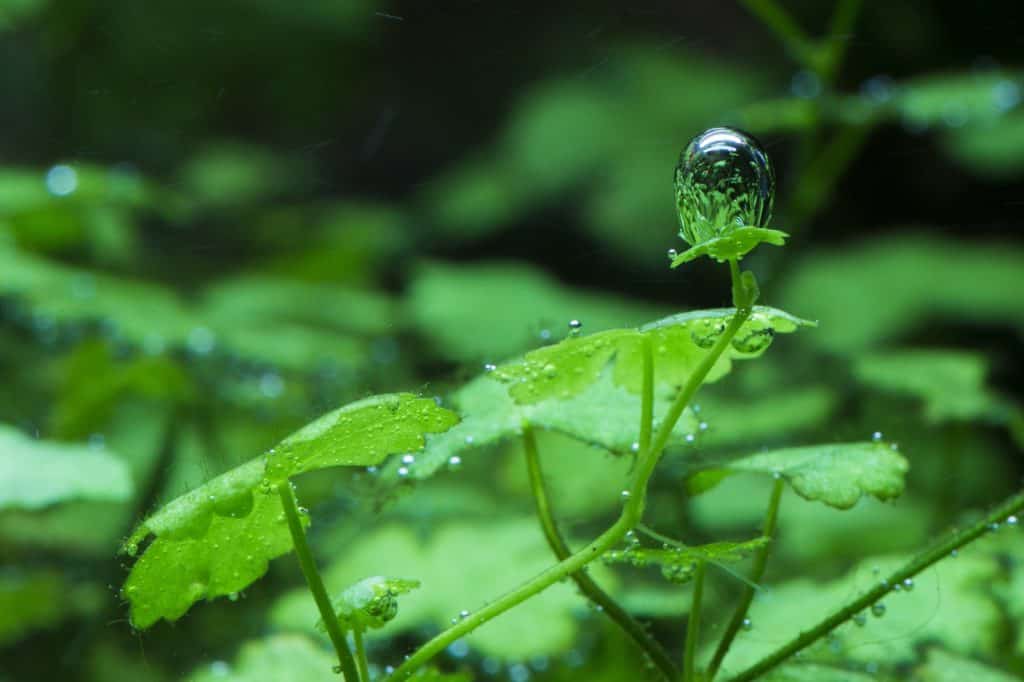
Hydrocotyle tripartita is best planted as a carpeting plant as it hugs the foreground and sends out runners on a daily basis. If the lighting in the tank is low, the plant could end up stretching up the tank walls; this will only happen with consistent low light conditions. Medium to high light conditions will result in lush growth. While some sources recommend compressing the plant to promote carpeting, this isn’t necessary, especially if a mat is placed in the tank where the plant is established. When new growth is starting to get out of control, pruning when necessary will ensure healthy and controllable growth. Injecting C02 will result in faster and more manageable growth.